


Table of Contents
- Understanding Wedding Favor Budget Per Guest
- Wedding Favor Cost Per Person: Real Spending Data
- How Many Wedding Favors to Order: Quantity Formula
- Using a Wedding Favor Budget Calculator
- Wedding Favor Ideas on a Budget
- Common Mistakes When Calculating Favor Budgets
- Frequently Asked Questions
Last Updated: October 16, 2026
Understanding Wedding Favor Budget Per Guest
The biggest mistake couples make is treating favors as an afterthought, picking a dollar amount without calculating how it breaks down across the actual guest count.
A wedding favor budget per guest is the amount you allocate for each attendee's keepsake, including the item, packaging, personalization, and shipping. Your favor budget isn't just the favor, it's the total landed cost when everything arrives at your venue.
What counts toward your favor budget
Your favor budget includes more than the item price. Account for:
- The item itself, the physical keepsake, whether jewelry, a personalized tumbler, or a small gift
- Packaging, boxes, bags, tissue, ribbons, or custom wrapping
- Personalization, engraving, monogramming, or custom printing with names or dates
Ignore any of these and your actual per-guest cost will exceed your plan. Many couples budget $3 per favor, then discover the total with packaging and shipping is closer to $5.
Hidden costs beyond the item price
Packaging deserves its own line item: a simple kraft box with tissue adds $0.50-$1.50 per favor, and custom boxes can double that. Personalization spikes costs fastest, monogramming a bracelet or engraving a tumbler adds $1-$3 per item, and guest names cost more. Shipping is often forgotten: on a 100-favor order, it can add $50-$150, or $0.50-$1.50 per guest.
Wedding Favor Cost Per Person: Real Spending Data
Typical spending ranges by wedding size
Couples typically spend $2-$8 per guest on favors, depending on wedding size and style. Smaller weddings (under 50 guests) often run higher per-guest because fixed costs like shipping split across fewer people: a 30-guest wedding might justify $5-$8 per favor, while a 200-guest wedding usually drops to $2-$4. Formal weddings lean toward the higher end; casual celebrations land at $2-$3.
Budget allocation within total wedding expenses
Wedding favors typically represent 1-2% of the total wedding budget. If your overall budget is $15,000, favors should consume roughly $150-$300. Your per-guest spend depends on total budget AND guest count: a $10,000 budget for 100 guests leaves roughly $1 per person (tight), while a $25,000 budget for 75 guests leaves roughly $6.67 per person (comfortable). Work backward from your overall budget: calculate 1-2% and divide by your expected guest count for your realistic per-guest ceiling.
How Many Wedding Favors to Order: Quantity Formula
Most guides say order one favor per guest and move on. That advice is incomplete, order quantity is a separate decision from your per-guest budget, and it changes the math. Here is the formula and the three quantity models.
The quantity formula
Start with this equation:
Order quantity = (base count × quantity model) + buffer
Where:
- Base count is your final RSVP guest count, not your invitation count. If 120 invitations go out and 88 people RSVP yes, your base count is 88.
- Quantity model is 1.0 for one favor per guest, roughly 0.6-0.8 for one favor per household, or the number of tables for one favor per table.
- Buffer is 5-10% for per-guest orders and 10-15% for personalized orders.
Per-guest: the default, and when it's right
One favor per guest is the safest choice, guests expect to leave with something. Use it when the favor is small and personal (jewelry, a mini candle, chocolates), when you're personalizing with names or initials, or when your guest list includes many singles or plus-ones you don't want to shortchange.
Example: 88 RSVPs × 1.0 = 88 favors. Add a 10% buffer for a personalized item: 88 × 1.10 = 96.8, round up to 97.
Per-household: the cost lever most couples miss
A household is a couple, a family, or a group sharing an invitation.
Example: 88 guests across 52 households × 1.0 = 52 favors. Add a 10% buffer: 52 × 1.10 = 57.2, round up to 58.
Compare the two: 97 favors versus 58 favors. At a $4 landed cost per favor, that's $388 versus $232, a $156 difference on the same guest list.
Per-table: the reception-centerpiece option
A third model places one favor per table, common when the favor doubles as part of the centerpiece, a small potted plant, a dessert tray, or a shared decorative item.
Example: 10 tables × 1.0 = 10 favors. Add a 20% buffer for setup damage: 10 × 1.20 = 12.
Per-table is the cheapest model by count, but it only works if the item is genuinely large enough to serve a table of eight to ten.
The buffer: why 5-10% is not optional
Order extras for four reasons:
- Damage. Boxes arrive crushed, glass chips, ribbons unravel. A 5% buffer covers normal breakage.
- Last-minute guests. Plus-ones and day-of additions happen.
- Vendors and wedding party. Photographers, planners, and your bridal party often expect a favor, count them in your base if you want them included.
Putting the quantity decision into your budget
Once you pick a model, plug the order quantity back into your per-guest budget calculation:
Cost per attending guest = (order quantity × landed cost per favor) ÷ RSVP guest count
Using the per-household example: 58 favors × $4 landed cost = $232 ÷ 88 guests = $2.64 per attending guest. The same favor ordered per-guest at 97 × $4 = $388 ÷ 88 = $4.41 per attending guest. Same item, same guests, different quantity model, and a 40% difference in what you actually spend per person. That is the number to compare against your overall favor budget cap, not the sticker price.
Using a Wedding Favor Budget Calculator
A favor budget calculator is only as good as the numbers you feed it. Most online calculators ask for item price and guest count, then ignore packaging, personalization, shipping, sales tax, and breakage, so the total is wrong, and usually low. Here is the full formula, a walkthrough, and worked examples.
The full landed-cost formula
Use this as your calculator, whether you build it in a spreadsheet or on paper:
Total favor cost = (item cost + packaging + personalization + inbound shipping per unit) × order quantity × (1 + sales tax rate) + breakage allowance + rush fees
Break down each line:
- Item cost is the per-unit price before anything else.
- Packaging is the box, bag, tissue, ribbon, or label per favor, a simple kraft box with tissue runs $0.50-$1.50; custom boxes run higher.
- Personalization is engraving, monogramming, or printing per item, roughly $1-$3 for common personalization, more for individual names.
Step-by-step calculation walkthrough
- Set your total favor budget cap. A common range is 1-2% of your overall wedding budget, $200-$400 on a $20,000 budget. Write it down before you shop.
- Confirm your RSVP guest count. Use final RSVPs, not invitations; if estimating early, use your expected acceptance rate.
- Choose your quantity model. Per-guest, per-household, or per-table sets your order quantity before buffer.
- Get a full quote from each supplier. Ask for item cost, packaging, personalization, shipping, sales tax, minimum order fees, and rush fees in one document.
- Calculate landed cost per favor. Add item, packaging, personalization, and shipping per unit, then apply sales tax.
- Multiply by order quantity including buffer for your true total.
- Divide by attending guests for your landed cost per guest, and compare it to your cap.
- Adjust one variable at a time. Change quantity model, drop personalization, or switch packaging, then recalculate, change three things at once and you won't know what moved the number.
Worked examples across guest counts and price tiers
These examples use realistic non-round numbers and include sales tax and breakage. Your quotes will differ, but copy the structure.
Example 1: 60-guest wedding, mid-tier personalized favor
- RSVP guests: 60
- Quantity model: per-guest, 1.0
- Order quantity with 10% buffer: 66
Example 2: 120-guest wedding, budget edible favor, per-household
- RSVP guests: 120
- Households: 74
- Quantity model: per-household, 1.0
Example 3: 200-guest wedding, premium keepsake, per-guest
- RSVP guests: 200
- Quantity model: per-guest, 1.0
- Order quantity with 10% buffer: 220
Notice what the examples show: the 120-guest wedding spends least per guest (per-household edible favor, no personalization), while the 200-guest wedding spends most (premium item, personalization, large buffer).
Where the calculator usually goes wrong
The three most common calculator errors:
- Leaving out sales tax. It applies to most orders and adds 6-9% depending on your state and locality.
- Leaving out the buffer. You pay for extras, so they belong in the total, not in a footnote.
- Using item price as landed cost. A $2.40 item with packaging, personalization, shipping, and tax is a $5.40 favor. Budgeting $2.40 per guest and spending $5.40 is how couples blow the favor line without realizing it.
Build the calculator once with all seven line items, then reuse it for every new favor idea, only the inputs change.
Wedding Favor Ideas on a Budget
Food and edible favors at lower price points
Edible favors are often the cheapest option. A small bag of gourmet chocolates, homemade cookies in a cellophane bag, or a jar of honey or jam typically costs $1-$2 per guest before packaging.
The downside: edible favors get consumed and forgotten. They're not keepsakes.
If budget is your only constraint, edible favors work. Pair them with a small printed card that explains what they are.
Personalized keepsakes that feel premium
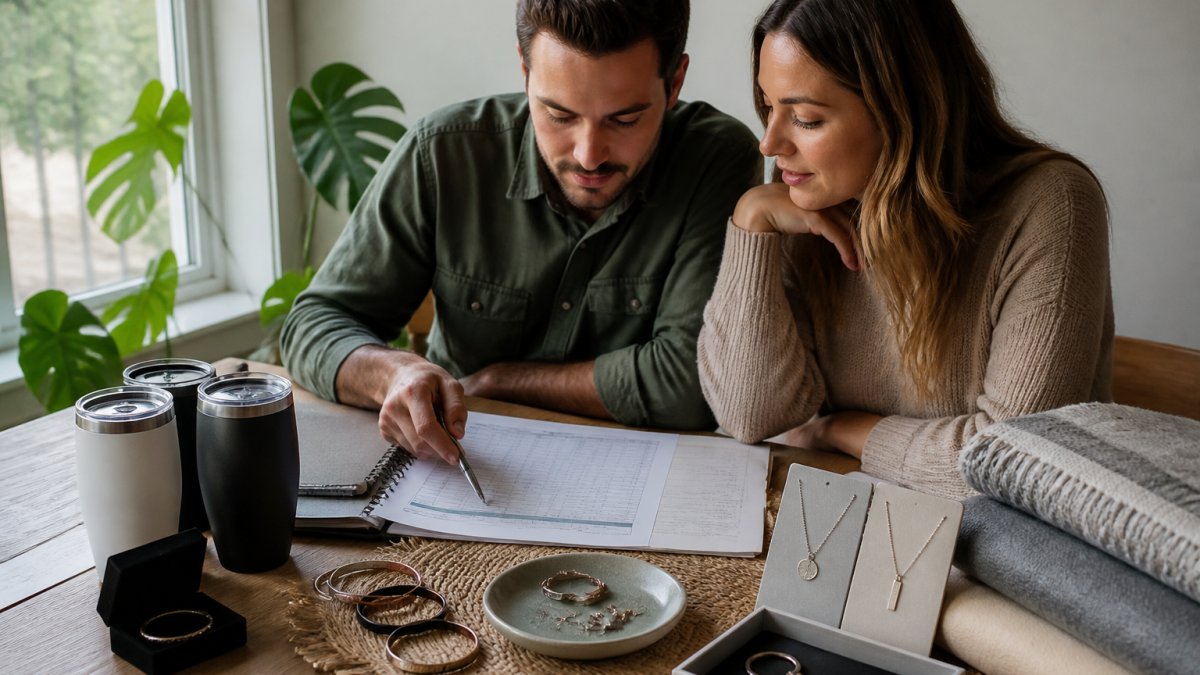
Personalized items hit the sweet spot between budget-friendly and memorable. A tumbler with your wedding date, jewelry with initials, or a candle with custom labels feels like a real keepsake.
Elvora Gifts specializes in personalized keepsakes designed to strengthen connections. Our jewelry, blankets, and custom items are built to last, so your guests will think of your wedding every time they use them.
DIY versus purchased: labor and time trade-offs
DIY favors save money but cost time: hand-assembling 100 favors takes 10-20 hours depending on complexity. DIY works if you enjoy the process and have help; it doesn't if you're already stressed with other wedding tasks. Purchased favors cost more upfront but save your sanity, order online, have them arrive personalized, and spend your energy on things only you can do.
Common Mistakes When Calculating Favor Budgets
Mistake 3: Choosing personalization you can't afford. If your budget is $2 per guest and personalization is $1.50, you've left $0.50 for the actual item.
Mistake 4: Not ordering extras. Order exactly 100 favors for 100 guests, one box arrives damaged, and suddenly you're paying rush fees for a replacement.
Calculating your wedding favor budget per guest takes 15 minutes but saves weeks of stress.
The goal isn't to spend the most. At Elvora Gifts, we help couples find personalized keepsakes that fit their budget and strengthen the connections that matter most.
Frequently Asked Questions
How do you calculate a wedding favor budget per guest?
Multiply your per-guest favor cost by your total guest count, then add packaging, shipping, and customization fees. For example, if you're spending $4 per favor item and have 100 guests, that's $400 before extras. Add 10-15% for packaging and personalization, plus any bulk ordering minimums. The total landed cost per guest will be higher than the item price alone. Use a wedding favor budget calculator to account for all these variables at once.
Should you order one wedding favor per guest or per couple?
Order one favor per guest unless you're giving table favors or couple-specific items. For individual favors, calculate based on headcount. If you're giving one favor per couple or per household, divide your guest count by 2 and adjust your quantity formula. Many couples order 5-10% extra favors to account for last-minute additions and breakage during shipping and setup.
What's a realistic wedding favor cost per person across different budgets?
Budget ranges vary widely. Small, practical favors (candy, seeds, candles) are available. Mid-range personalized items (custom mugs, blankets, keepsakes) are also available. Premium personalized keepsakes and jewelry are also available. Your total per-guest spending depends on your overall wedding budget and guest count. Couples with 50 guests can allocate more per person than those with 200 guests on the same total budget.
How can you save money on wedding favors without making them feel cheap?
Choose one meaningful, personalized item over multiple trinkets. Bulk ordering from suppliers offering minimum order discounts significantly reduces per-unit costs. Food and edible favors often deliver high perceived value at lower prices. DIY assembly (adding custom labels or packaging to simpler items) saves money while adding a personal touch. Ordering early locks in better pricing and avoids rush fees. Memorable, thoughtful favors, even modest ones, matter more to guests than expensive items.


