


Table of Contents
- Define Your Gifting Objectives and Align With Corporate Goals
- Identify Your Target Audience and Personalization Approach
- Setting a Realistic Corporate Gifting Budget
- Choose the Right Gift Types and Selection Criteria
- Evaluate Corporate Gifting Platforms and Vendors
- Corporate Gifting Best Practices for Timing and Cadence
- Measure Corporate Gifting ROI and Performance
- Tax Compliance, Legal Considerations, and Sustainability
Last Updated: July 25, 2026
Define Your Gifting Objectives and Align With Corporate Goals
Corporate gifting works best when tied to specific business outcomes. Many organizations send gifts without clear purpose, treating them as an afterthought rather than a strategic tool. At Elvora Gifts, we've observed that companies with defined gifting objectives see measurable improvements in relationship strength and employee satisfaction.
Your gifting strategy should answer: what business outcome are you trying to achieve? Are you strengthening client relationships, recognizing employee milestones, building brand loyalty, or improving retention rates? This clarity shapes every decision that follows, from budget allocation to gift selection to timing.
Map your gifting to specific business outcomes. If your goal is client retention, align your gifting calendar with key relationship touchpoints: contract renewals, project completions, or quarterly business reviews. If employee appreciation is the focus, tie gifts to performance milestones, tenure anniversaries, or team achievements. Research from McKinsey's insights on employee engagement shows that recognition programs directly tied to business outcomes drive measurable performance improvements.
Document your primary objectives in writing, including metrics that define success: improved employee engagement scores, higher client retention rates, or increased repeat business. Without this clarity, your gifting efforts scatter across too many purposes and lose effectiveness.
Identify Your Target Audience and Personalization Approach
Segmenting your recipient list is where corporate gifting strategy becomes genuinely powerful. A single gift sent to everyone misses the mark for most recipients. Personalization is no longer optional, it's the difference between a gift that gets used and one that gets forgotten.
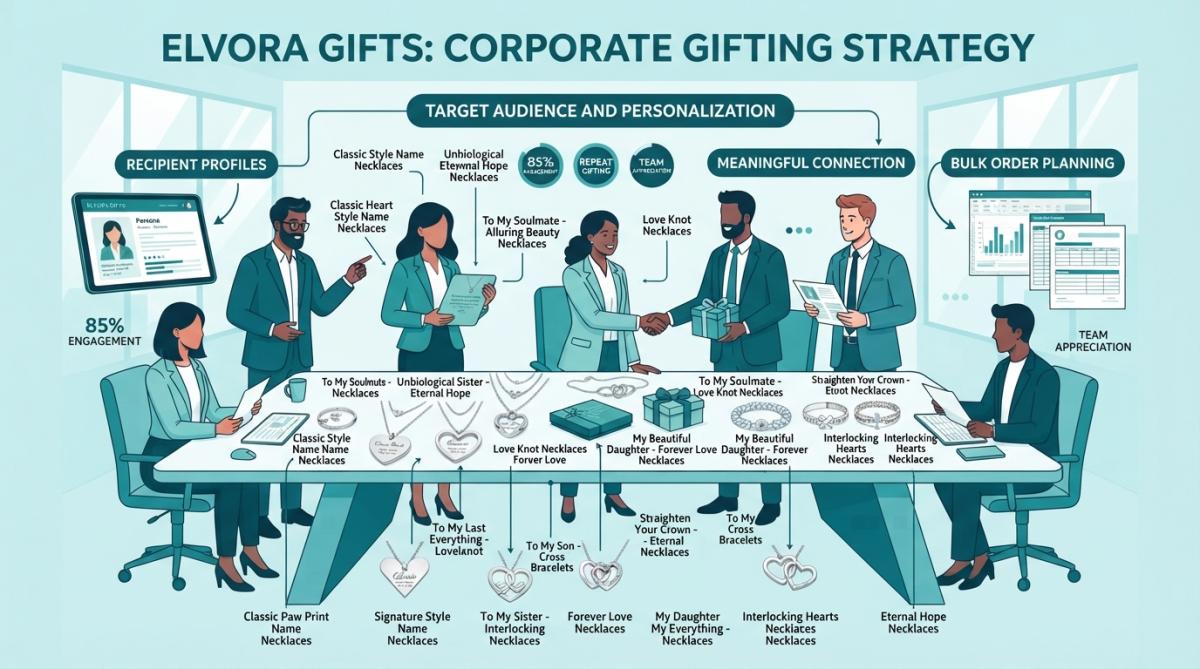
Divide your audience into meaningful segments. For clients, segment by revenue tier, industry, tenure, or relationship strength. For employees, segment by department, tenure, role level, or performance tier. Each segment should have different gifting needs and preferences.
Within each segment, develop customization strategies that resonate. This doesn't mean unique gifts for every person, but gifts that feel relevant to their context. For clients, customize the gift message or packaging to reference their specific partnership. For employees, vary gifts by department or recognize specific achievements rather than sending identical items to everyone.
Personalization extends beyond the gift itself to the recipient experience. Include a handwritten note or personalized message card that references something specific about the relationship, a project they led, a milestone they reached, or a value they embody. This transforms a generic gift into a meaningful gesture.
Develop a simple matrix showing each audience segment and their preferred gift categories. Some audiences prefer experiential gifts, others prefer practical items, and still others prefer luxury goods. Ask yourself: what would make this person feel genuinely appreciated?
Setting a Realistic Corporate Gifting Budget
Budget allocation is where many gifting strategies derail. Organizations either underfund their programs and undermine their impact, or overfund them without clear ROI.
Start with per-recipient spend as your foundation. Calculate total spend by multiplying per-recipient cost by total recipients, then add 15-20% for contingencies, rush orders, and unforeseen needs.
Account for hidden costs that most organizations overlook. Personalization and customization add 10-30% to base gift costs. Shipping and fulfillment add another 10-20%. Gift wrapping with personalized messages (like Elvora Gifts' Gift Wrap with Personalized Message service at $7.95 per item) elevates presentation but adds cost. Package protection insurance covers loss, theft, and damage during shipping.
Consider your gifting cadence when setting budget. If you're gifting quarterly, your annual budget needs to accommodate four separate campaigns. If you're gifting only at year-end, you can concentrate spending.
| Budget Component | Typical Range | Notes |
|---|---|---|
| Base gift cost | 40-60% | Varies by gift type and quality |
| Personalization | 10-30% | Customization, engraving, messaging |
| Shipping & fulfillment | 10-20% | Higher for international, lower for bulk |
| Wrapping & packaging | 5-15% | Optional but impacts perception |
| Contingency buffer | 15-20% | Rush orders, replacements, mistakes |
Build your budget bottom-up rather than top-down. Calculate per-recipient spend for each segment, multiply by recipient count, add fulfillment costs, and arrive at your true budget. This ensures your budget actually supports your strategy.
Choose the Right Gift Types and Selection Criteria
Gift selection is where strategy meets execution. The right gift reinforces your brand values and resonates with recipients.
Match gift categories to recipient preferences and context. Luxury goods work for high-value client relationships and executive recognition. Practical items like premium writing instruments or quality tech accessories work for broad employee gifting. Experiential gifts create memorable moments. Personalized keepsakes from Elvora Gifts, including jewelry and customized items, work when you want to signal lasting appreciation.
Quality, brand alignment, and recipient experience are your three decision criteria. A gift should reflect your company's standards and values. Premium gift wrapping and presentation significantly improve the unboxing experience. A personalized note explaining why you chose this specific gift for this specific person elevates the entire gesture.
Build a gift selection matrix for each audience segment with 3-5 gift options per segment, including specific product names, costs, and customization options. This prevents decision paralysis and ensures consistency across your program.
Evaluate Corporate Gifting Platforms and Vendors
Choosing the right platform or vendor determines whether your gifting strategy executes smoothly or becomes an administrative nightmare.
Evaluate platforms on three core dimensions: customization capabilities, fulfillment infrastructure, and CRM integration. Can the platform handle the personalization your strategy requires? Can it fulfill orders at the scale and speed you need? Can it integrate with your existing systems?
Customization features matter significantly. Some platforms offer basic personalization; others provide deep customization with custom messaging, branded packaging, and variable designs. Choose based on how central personalization is to your strategy.
Fulfillment logistics determine whether gifts arrive on time and in good condition. Ask vendors about fulfillment timelines, error rates, and rush order handling. Request references from other corporate clients and verify their actual experience.
CRM and HRIS integration reduces manual work and prevents errors. If your platform can pull recipient data directly from your CRM or human resources system, you eliminate spreadsheet management and reduce the chance of duplicate orders or missed recipients.
Corporate Gifting Best Practices for Timing and Cadence
Timing determines whether your gift lands as meaningful recognition or feels random. A gift sent at the right moment reinforces a relationship.
Plan your gifting cadence around natural relationship touchpoints. Quarterly gifting ties to business cycles and seasonal moments. Milestone recognition, contract anniversaries, tenure milestones, project completions, creates specific, earned moments for appreciation.
A quarterly gifting cadence provides consistent touchpoints without overwhelming your budget or logistics. Q1 might focus on new year momentum. Q2 might recognize mid-year achievements. Q3 might acknowledge summer client relationship maintenance. Q4 might be your major year-end recognition push.
Milestone recognition carries particular power because it's earned and specific. When you gift at contract renewal, you're acknowledging a relationship that has proven its value. When you gift at tenure milestones, you're recognizing loyalty and commitment. When you gift after a successful project completion, you're celebrating shared achievement.
Avoid common timing mistakes. Don't send gifts so late that they feel like an afterthought; send them within 2-4 weeks of the achievement. Don't send gifts during chaotic periods when recipients are too overwhelmed to appreciate them. Don't cluster all gifting into November-December; spread recognition across the year.
Build your gifting calendar 6-9 months in advance, mapping out each campaign: target audience, gift selection, personalization requirements, fulfillment timeline, and send date. This advance planning gives you time to negotiate with vendors and avoid last-minute scrambles.
Measure Corporate Gifting ROI and Performance
ROI measurement separates data-driven gifting strategy from guesswork. Without metrics, you can't optimize your program or justify continued investment.
Define KPIs aligned to your original objectives. If your goal is client retention, measure retention rate before and after gifting campaigns. If your goal is employee satisfaction, measure engagement scores and voluntary turnover. If your goal is brand perception, measure Net Promoter Score or brand sentiment.
Track data-driven results across your recipient segments. Different segments may respond differently to your gifting strategy. Segment your analysis to identify which audiences benefit most from your program.
Implement post-gift feedback loops to understand recipient perception. Send a brief survey 1-2 weeks after recipients receive gifts, asking whether they received it, liked it, and would recommend it. Use this feedback to refine your gift choices for future campaigns.
Track fulfillment metrics alongside business metrics. Monitor on-time delivery rates, quality issues, and customer service inquiries related to gifts. Fulfillment performance directly impacts the recipient experience and your program's ROI.
Calculate simple ROI by comparing the cost of your gifting program to the business value it generates. If you spent $50,000 on client gifting and it contributed to retaining 10 clients worth $500,000 in annual revenue, your ROI is substantial.
| Metric | How to Measure | Target Benchmark |
|---|---|---|
| Client retention rate | % of clients retained year-over-year | +5-10% improvement post-gifting |
| Employee engagement | Annual engagement survey scores | +10-15 point improvement |
| Voluntary turnover | % of employees leaving annually | -2-5% improvement |
| Gift satisfaction | Post-gift survey satisfaction score | 80%+ satisfaction |
| Fulfillment on-time rate | % of gifts delivered by target date | 95%+ on-time |
| Cost per relationship strengthened | Total program cost ÷ engaged recipients | $50-$200 depending on segment |
Tax Compliance, Legal Considerations, and Sustainability
Corporate gifting involves legal and tax implications that many organizations overlook.
Understand taxable fringe benefits and IRS guidelines. Gifts to employees are generally taxable income if they exceed certain thresholds. The IRS allows up to $100 per employee per year in de minimis fringe benefits. Gifts exceeding this amount must be reported as taxable compensation. Consult your tax advisor to ensure your gifting program complies with current IRS regulations.
Document your gifting program in writing, defining eligible recipients, spending limits, and approval processes. This documentation protects your organization if audited and ensures consistent application across departments.
Ethical sourcing and sustainable gifting practices increasingly matter to recipients and reflect your brand values. Choose vendors who can document their supply chain, labor practices, and environmental impact. Select gifts made from sustainable materials or produced by ethical manufacturers when possible.
Consider the lifecycle impact of your gifts. Personalized keepsakes from Elvora Gifts, including jewelry and customized items, tend to have longer lifecycles because recipients keep meaningful, personalized items longer than generic products.
Document your sustainability commitments in your gifting policy. If you're prioritizing ethical sourcing or sustainable materials, communicate this to recipients, it enhances the meaning of the gift and signals your company values.
Building an effective corporate gifting strategy requires clarity on objectives, intentional audience segmentation, realistic budgeting, and consistent execution. The most successful programs tie gifts directly to business outcomes and measure their impact. When you're ready to implement your strategy, Elvora Gifts offers a curated selection of high-quality gifts including personalized keepsakes, jewelry, and customized items that strengthen relationships. With free shipping on orders over $70 and options for gift wrapping with personalized messages, Elvora Gifts simplifies the execution of your corporate gifting strategy while maintaining the premium quality and meaningful personalization your relationships deserve. Start building your gifting calendar today and transform how you recognize and appreciate the people who matter most to your business.
Frequently Asked Questions
What is a corporate gifting strategy and why does it matter?
A corporate gifting strategy is a structured plan that defines your objectives (client retention, employee appreciation, relationship building), target recipients, budget allocation, gift selection criteria, and measurement methods. It matters because a thoughtful strategy aligns gifts with business goals, improves recipient experience, strengthens relationships, and ensures consistent brand alignment. Without strategy, gifting becomes reactive and unmeasurable, wasting budget on gifts that don't drive engagement or reinforce your corporate culture.
How do I create a realistic corporate gifting budget?
Start by determining your total annual gifting spend, then divide by the number of recipients to establish per-person budgets. Consider three tiers: high-value clients or executives (higher per-person spend), mid-tier relationships (moderate spend), and broader touchpoints like trade show giveaways (lower spend). Account for hidden costs: personalization fees, gift wrapping ($7.95 at Elvora Gifts for wrapped items with personalized messages), package protection ($2.98), fulfillment, and vendor markup. Build in a 10-15% contingency. Review quarterly to adjust allocation based on ROI data and engagement scores.
What are the best practices for measuring corporate gifting ROI?
Define clear KPIs before launching: client retention rate, repeat purchase frequency, employee engagement scores, or relationship strength metrics. Track data-driven results using CRM integration to monitor recipient interactions post-gift. Implement post-gift feedback loops, surveys or follow-up calls asking about recipient satisfaction and perceived value. Compare metrics 30, 60, and 90 days after gifting. Calculate ROI by dividing total revenue attributed to gifting relationships by total gifting spend. Adjust your gifting cadence and gift selection based on which touchpoints drive the highest engagement and customer lifetime value.
How do corporate gifting platforms and drop-shipping fulfill large orders?
Corporate gifting platforms streamline fulfillment through drop-shipping partnerships, allowing you to order personalized items without holding inventory. You select gifts, customize them through the platform's interface, and the vendor ships directly to recipients. Platforms handle procurement, vendor management, and logistics. Key features include batch ordering (sending 15+ gifts without manual processing), automated personalization, tracking systems, and integration with your CRM or HRIS for recipient data. Confirm turnaround times and delivery guarantees before committing; reputable vendors provide clear timelines and package protection options to prevent loss or damage.
Are corporate gifts taxable, and what compliance rules apply?
Under IRS guidelines, corporate gifts are generally taxable fringe benefits if they exceed $25 per recipient per year. Gifts under $25 may qualify as de minimis fringe benefits (non-taxable). However, rules vary by gift type and recipient relationship. Gifts to clients are business deductions but taxable income to the recipient if they exceed $25. Gifts to employees are taxable wages unless they meet specific exemptions. Document all gifting spend for tax purposes and consult your tax advisor or HR department about compliance. Maintaining clear records of gift type, cost, recipient, and business purpose protects your organization during audits.
How do I ensure personalized gifts actually look premium and not homemade?
Quality matters enormously. Choose established retailers with proven manufacturing standards and customer reviews, Elvora Gifts, for example, specializes in premium selections including exquisite jewelry, cozy blankets, and personalized keepsakes designed to feel thoughtful, not cheap. Avoid over-customization; a subtle monogram or engraved name on a high-quality item (like jewelry) looks elegant, while excessive personalization can cheapen the gift. Request samples before bulk orders. Use professional gift wrapping services (Elvora offers personalized message gift wrap for $7.95) to elevate presentation. Pair gifts with a personalized note explaining the gesture, this context transforms a gift from generic to genuinely meaningful.
What gifting cadence and timing strategy works best for relationship building?
A multi-touchpoint approach works best: quarterly gifting for key relationships (clients, partners), milestone recognition (anniversaries, promotions, contract renewals), seasonal gestures (holidays, year-end), and event-based giveaways (trade shows, conferences). Avoid clustering gifts, space them throughout the year to maintain consistent engagement and prevent gift fatigue. Plan campaigns 6-8 weeks in advance to allow for customization, fulfillment, and delivery without rushing. Align gifting cadence with your sales cycle and relationship milestones. Track which timing generates the highest engagement scores; some industries respond better to Q4 gifting, others to spring touchpoints. Use automation and CRM integration to trigger gifts based on recipient actions or anniversaries, ensuring no key relationship is overlooked.
This article was written using GrandRanker


