


Table of Contents
- Why Thank You Notes Still Matter in 2026
- Handwritten vs Email Thank You Notes: The Core Differences
- Thank You Note Etiquette: Timing, Tone, and Recipient Expectations
- Thank You Note Examples for Interviews That Get Remembered
- Thank You Note Templates for Business: Clients, Employees, and Partners
- Generational Differences and Cultural Etiquette Variations
- The Environmental Impact of Paper vs Digital Correspondence
- Frequently Asked Questions
Last Updated: September 15, 2026
Why Thank You Notes Still Matter in 2026
In an era when the average professional inbox holds hundreds of unread messages, a handwritten vs email thank you notes decision carries more weight than most people realize. This guide from Elvora Gifts breaks down when each format earns its place and how to choose without second-guessing yourself.
Thank you notes remain one of the few communication forms that signal genuine appreciation rather than obligation. According to the Emily Post Institute's guidance on thank-you notes, a written note acknowledges a gift, gesture, or kindness in a way that spoken words cannot replicate. The format you choose, however, changes how that message lands.
Here's what most guides get wrong: they treat handwritten and email notes as interchangeable, when the real distinction comes down to relationship depth and context. Below, we'll show you how to match the format to the moment, with templates you can use today.
Handwritten vs Email Thank You Notes: The Core Differences
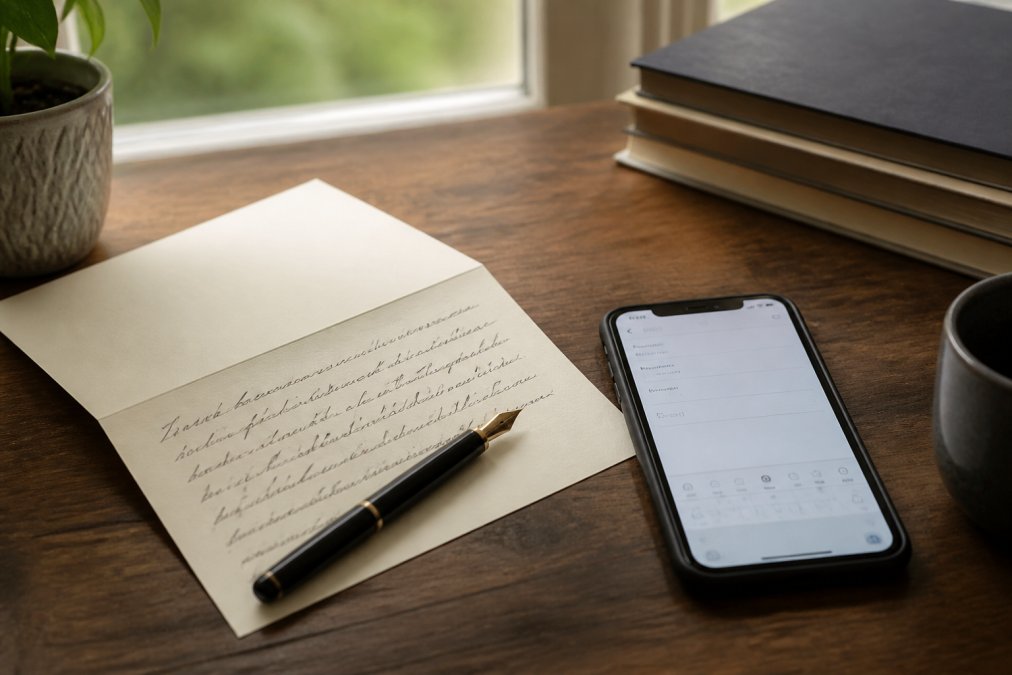
The core difference between handwritten and email thank you notes is the trade-off between personal touch and speed: handwritten notes signal effort, while email delivers immediate convenience.
The Tactile Experience and Psychological Impact
A handwritten note requires the recipient to hold something physical, creating a stronger memory anchor than a screen notification. Many professionals keep handwritten notes for years, while emails get archived within days.
The psychological impact goes beyond nostalgia. A handwritten note implies the sender sat down, chose stationery, and wrote without spell-check. That perceived effort translates into sincerity.
Speed, Convenience, and Digital Correspondence
Email wins on turnaround time. A hiring manager can receive an email thank you within an hour of an interview, while a handwritten note may take days to arrive.
Digital correspondence also scales: thanking twenty clients after a corporate event is practical by email without sacrificing thoughtfulness, provided you personalize each message.
Thank You Note Etiquette: Timing, Tone, and Recipient Expectations
Thank you note etiquette comes down to three variables: turnaround time, formality level, and what the recipient expects from your relationship. Get these right, and the format choice becomes obvious.
Turnaround Time and Delivery Expectations
For email, aim to send within 24 hours; for handwritten notes, within one week of receiving a gift or attending an interview (Emily Post's Complete Guide to Writing Thank You Notes). A common mistake is waiting too long for perfection, a timely, sincere note beats a delayed, polished one.
Formal vs Informal: Matching the Occasion
Formal occasions, such as a job interview or a client gift, call for handwritten correspondence on quality stationery. Informal situations, like thanking a coworker for covering your shift, work fine over email. When in doubt, match the formality of the relationship, not just the event.
| Situation | Recommended Format | Turnaround Time | Formality Level |
|---|---|---|---|
| Job interview follow-up | Handwritten or email | 24 hours to 1 week | Formal |
| Client gift acknowledgment | Handwritten | Within 1 week | Formal |
| Coworker favor | 24 hours | Informal | |
| Employee recognition | Handwritten | Within 3 days | Semi-formal |
| Networking introduction | 24-48 hours | Semi-formal |
Thank You Note Examples for Interviews That Get Remembered
The strongest thank you note examples for interviews reference a specific moment from the conversation. Generic gratitude fades fast; specificity proves you were present.
A handwritten post-interview note might read:
Dear Ms. Chen,
Thank you for taking the time to discuss the marketing coordinator role with me yesterday. Your point about rebuilding the client onboarding process stuck with me, and I've already started thinking through how I'd approach the first 90 days. I appreciate the opportunity and hope to continue the conversation.
Sincerely, Jordan
An email version follows the same structure but can be sent within hours. The Society for Human Resource Management's guidance on candidate experience notes that thoughtful follow-up communication influences how candidates and employers perceive each other throughout the recruitment process.
Thank You Note Templates for Business: Clients, Employees, and Partners
Thank you note templates for business should sound like you, not a form letter. The fastest way to lose impact is sending something that reads like a mass mail merge.
For a client who placed a large order, a handwritten note paired with a small gift creates a memorable moment. Elvora Gifts offers a gift wrap with personalized message option that pairs well with client appreciation gestures, adding a handwritten touch without sourcing stationery yourself.

For employee recognition, a handwritten note left on a desk often lands harder than a company-wide email. For business partners, email works well when the relationship is established and the note is one of many touchpoints.
- Client thank you: handwritten note plus a thoughtful keepsake for high-value relationships
- Employee thank you: handwritten note for personal milestones, email for team-wide wins
- Partner thank you: email for routine check-ins, handwritten for contract renewals or anniversaries
Generational Differences and Cultural Etiquette Variations
Most advice on handwritten vs email thank you notes treats the recipient as a generic professional. In practice, generation and cultural context change which format reads as respectful rather than lazy or performative. Here is a decision framework you can apply before you write.
Generational Preferences: What the Patterns Actually Look Like
The commonly cited pattern is that older recipients value handwritten correspondence while younger recipients default to digital. That pattern is real but incomplete, and treating it as a rule produces mistakes in both directions.
A more useful way to think about it is through formative communication norms. People tend to treat as "normal" the format that dominated their early professional years:
- Recipients who entered the workforce before email was standard often read a handwritten note as the baseline of courtesy. An email thank you in a formal context can register as a shortcut, even when the content is sincere.
- Recipients who entered the workforce during the email era generally treat a prompt, well-written email as fully sufficient for most situations. A handwritten note still stands out, but it is read as a bonus rather than a requirement.
- Recipients who entered the workforce during the messaging and social era often prefer speed and low friction. A handwritten note can feel slow or slightly formal, but it also tends to be remembered precisely because it is unusual in their inbox.
A Quick Decision Framework
Run the situation through three questions:
Cultural Etiquette Variations: What Changes Across Contexts
What This Means for Your Format Choice
The Environmental Impact of Paper vs Digital Correspondence
The Real Trade-Offs
A Practical Sustainability Framework
What to Do If You Want to Minimize Impact
Frequently Asked Questions
Are email thank you notes acceptable in a professional setting?
Yes, email thank you notes are widely accepted in professional settings, especially when speed matters. After a job interview, an email sent within 24 hours shows genuine appreciation and keeps you top of mind with the hiring manager. For client relations or networking, email works well for quick follow-up. However, for high-stakes moments like a final interview or a major client milestone, a handwritten note carries more weight because it signals extra effort and thoughtfulness.
How quickly should a thank you note be sent?
Timing depends on the format. Email thank you notes should go out within 24 hours of the event or interview, while handwritten notes can be sent within 48 hours to one week. For job interviews, a same-day or next-morning email is standard, and a handwritten follow-up can arrive later as a reinforcing gesture. For weddings, gifts, or client appreciation, handwritten notes within two weeks are considered appropriate. The key is not letting the moment pass without acknowledgment.
Why are handwritten thank you notes considered more meaningful?
Handwritten notes require more effort and personal touch than typing an email. The tactile experience of opening an envelope, seeing someone's handwriting, and holding a physical card creates a stronger emotional connection. In a business context, a handwritten note stands out because so few people send them. Recipients often keep handwritten notes for years, while emails get buried in crowded inboxes. That lasting impression makes handwritten correspondence a powerful tool for relationship building.
What is the best way to send a thank you note after an interview?
Send an email thank you note within 24 hours to each interviewer, referencing a specific topic from your conversation. This keeps your name in front of the hiring manager while the interview is fresh. If you want to stand out, follow up with a handwritten note mailed to the office within the same week. The email handles speed and professionalism, while the handwritten version adds a personal touch that few candidates bother with. Together, they reinforce your genuine appreciation.
Choosing between handwritten and email thank you notes is really a question of relationship investment. When the connection matters enough to slow down, a handwritten note carries weight that no inbox can replicate. Elvora Gifts helps you pair that personal touch with premium gifts, from personalized keepsakes to cozy blankets and jewelry, all with free shipping on orders over $70. Get started with Elvora Gifts and turn your appreciation into something your recipient will actually keep.


